strands

last updated: June 13, 2026
attention surfing #
June 13, 2026
When a distraction arises, silently note: “There’s the ‘distracting’ thought,” then visualize it as a cloud passing or a leaf floating down a stream—while your hands stay on the keyboard. The goal isn’t to stop the thought but to not fuse with it. After 10 seconds, return to work.
- “Attentional Surfing” (Metacognitive Therapy):
- What it is: Observing distracting urges with detached awareness, rather than fighting them or obeying them.
- How to practice: When a distraction arises (e.g., urge to check email), silently note: “There’s the ‘check email’ thought,” then visualize it as a cloud passing or a leaf floating down a stream—while your hands stay on the keyboard. The goal isn’t to stop the thought but to not fuse with it. After 10 seconds, return to work.
- Why it works: Builds meta-awareness of your cognitive patterns, reducing the perceived “urgency” of distractions. Neuroimaging shows this weakens the default mode network’s grip over time.
Feel the physical sensations
git stuff #
June 13, 2026 - indispensible git snippets i should just learn off by heart
Checkout file from another branch
git checkout main -- app/commands/update_approval_request.rb
Undo latest commit
git reset HEAD~
Completely remove last three commits (HEAD~ [aka HEAD], HEAD~1, HEAD~2)
git reset --hard HEAD~2
Reset last commit to changes
git reset --soft HEAD~1
Reset a branch to a specific commit in history
git reset --hard <sha>
# remember to force push afterwards
Recovering after committing with a loose HEAD
git branch tmp
git checkout <desired_branch>
git merge tmp
imagemagick dithering #
June 13, 2026 - Creating tiny PNGs with imagemagick
Define your palette:
magick -size 1x1 xc:"#2e0000" xc:"#800000" xc:"#ff0000" xc:"#ffcccc" +append palette.png
And then in a single step take a large full-colour image, tweak it to look good with a limited palette and apply Floyd-Steinberg dithering:
magick DSCF0290.JPG \
-brightness-contrast -30,-20 \
-resize 720x \
-dither FloydSteinberg \
-remap palette.png \
-strip \
output.png
crazytalk #
June 13, 2026 - ravings
“in the end you’ll realise that most of your life is just the sum of relationships”
“it’s like i’m constantly preparing for something but i never do it”
On playing the game:
the “trick” is to actually have something better to do – your mission
internal belief on why i don’t like loyalty programs:
- data harvesting (trading savings for my personal data)
- loyalty programs become attractive when your life becomes stable and predictable enough that you are willing to sacrafice variety for consistency
- does my resistance imply that i am not ready to accept this phase of life and that it is perhaps the last small hurdle that i am denying to accept, even though i am basically there?
- either way, it probably indicates a longing for life in which loyalty programs are not a realistic option.
- maybe i should stop living/judging my life through hypothetical proxies
thinking makes you feel like you’re doing something responsible
motivation to start, discipline to keep going
cheap mental novelty as a reward, which presents purely as distraction
the learn thing about learn things #
June 13, 2026 - Learning is hard. It feels like scratching and etching in your brain with a sharp object. If you remember, you've got the scars.
actually remembering what I read #
June 13, 2026 - Procedurally engage with what you read - Jeffrey Kaplan's technique
Stop passing your eyes over the words! Engage with the content by summarising in the margins.
Procedure: Summarise each paragraph in a single sentence. For each new paragraph, add an additional sentence that summarises all preceding paragraphs.
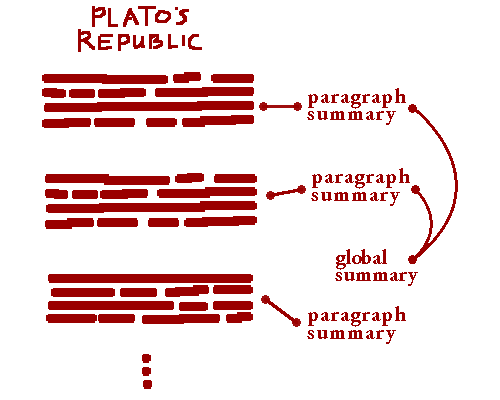
# if my brain worked like an llm
foreach paragraph in text {
  write_summary(paragraph)
  write_global_summary(paragraphs_summarised)
  paragraphs_summarised.push(paragraph)
}
Kaplan’s marginalia method is a script for engaging with reading material in a way that more reliably leads to retention. You are extracting the core meaning from each paragraph (“paragraph summary”) and further contexualising it by mixing in preceding paragraphs (“global summary”). This forces you to consider how paragraphs are related and, hopefully, cements ideas as you think through them. It will also lead you to think about the overarching ideas of the whole text.
I’ve been rationalising to myself that reading lazily is better than not reading at all, but that’s probably not true – I could be doing better things with my time than reading poorly.